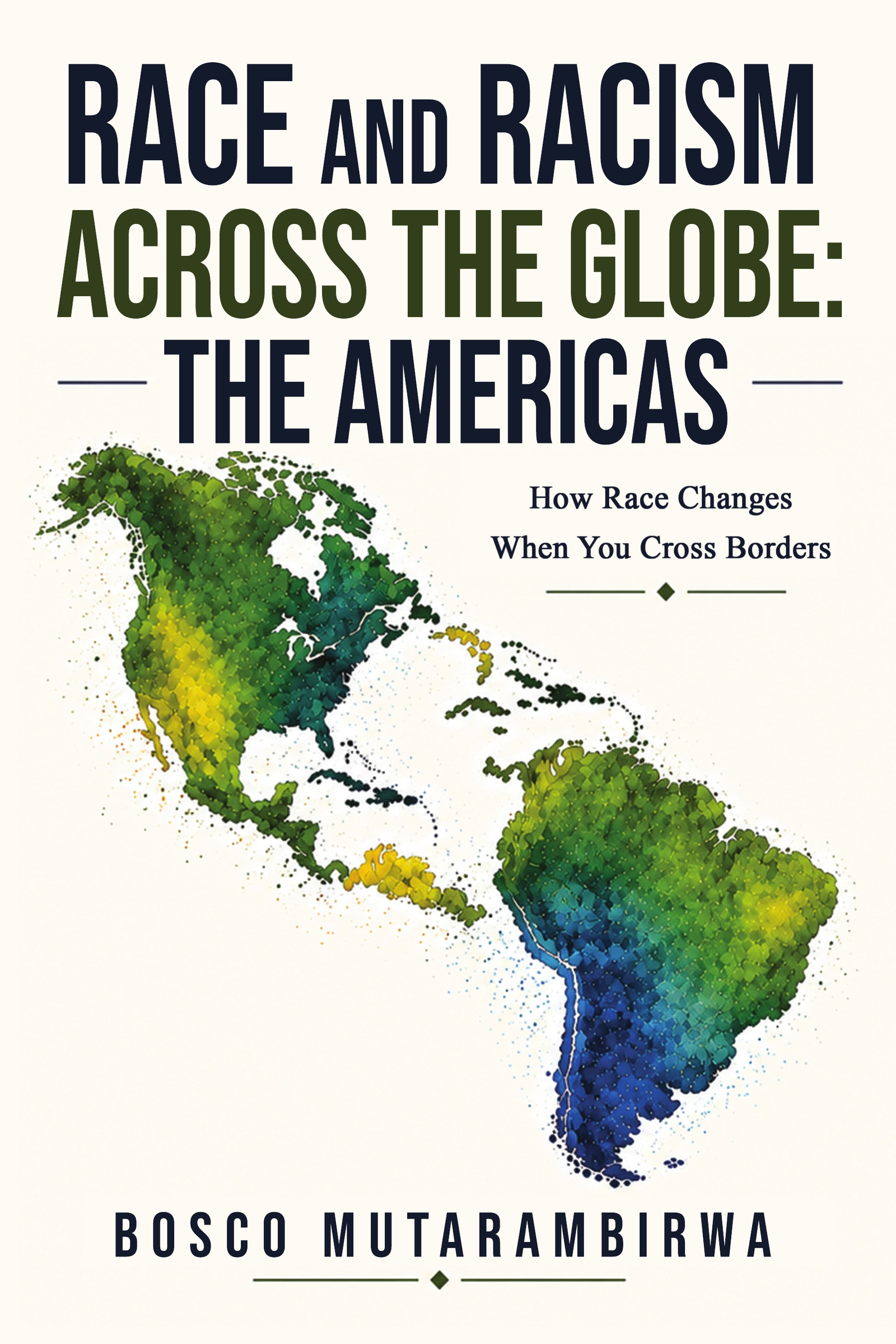
Race feels obvious until it moves. A person can cross a border and discover that the categories they grew up with no longer explain how they are seen. A word that sounds neutral in one country may be politically charged in another. A person understood as mixed at home may be read as Black abroad. Nationality, color, class, ancestry, language, migration, and law can all rewrite the rules.
Race and Racism Across the Globe: The Americas compares the United States, Brazil, Canada, Mexico, the Dominican Republic and Haiti, Colombia, Argentina, and the wider hemisphere. Through narrative scenes, public data, legal frameworks, history, and comparative analysis, it shows how race is named, denied, measured, enforced, softened, and contested across borders.
Written for general readers as well as students, educators, libraries, and professionals, the book explains complex systems without reducing every country to the U.S. Black-and-white binary. It is the first volume in a five-book global series.
Translation offers are currently invited only for:
- Brazilian Portuguese,
- neutral Latin American Spanish,
- French,
- Dutch,
- German, and
- Japanese.
Offers into other languages will not be considered at this stage.
Native-language translators with experience in nonfiction, history, sociology, race, ethnicity, migration, or related subjects are strongly preferred. Translator-editor teams are especially welcome. Applicants should demonstrate careful handling of culturally sensitive and country-specific terminology, readable prose, reliable communication, and a realistic schedule for a manuscript of approximately 69,000 words. Unreviewed machine translation will not be accepted.
Genre: SOCIAL SCIENCE / Discrimination & Race RelationsThe English edition is professionally published and available in hardcover, paperback, Kindle, and Kindle Unlimited. It is the first volume in a five-book global series.
The subject has direct relevance to Brazilian and Spanish-speaking readers because the book devotes substantial attention to Brazil, Mexico, the Caribbean, Colombia, Argentina, migration, national identity, and the translation of racial categories across borders.
The book is evergreen rather than tied to one news cycle and can appeal to general readers, students, educators, libraries, diaspora readers, travelers, and professionals working across the Americas.
The rights holder will provide localized cover production, metadata support, website promotion, social-media promotion, review outreach, and cross-promotion with future volumes in the series.
She did not become darker when she landed in America.
She became more legible to a different racial system.
In Brazil, people had not always agreed on what to call her. Some saw morena. Some saw parda. Some saw preta. Some said negra in a political sense. Some avoided the sharpness of race altogether and spoke instead through color, beauty, family, or class. The answer could shift depending on who was speaking, where they were standing, and what kind of conversation they were willing to have.
In the United States, the question changed.
People did not always ask what shade she was. They asked what category she belonged to. Was she Black? Latina? Afro-Latina? Multiracial? A woman of color? Was Brazilian the answer, or was Brazilian only nationality? If she was not Hispanic, could she still be Latina? If she was mixed, did that make her less Black, differently Black, or not Black at all?
The confusion did not come from ignorance alone.
It came from translation.
Blackness does not mean the same thing everywhere. It can be a color, an ancestry, a political identity, a social assignment, a census category, a national stigma, a cultural inheritance, a legal history, or a position in a hierarchy.
The question “Who counts as Black?” sounds simple only until the border answers.
| Language | Status |
|---|---|
|
Spanish
|
Translation in progress.
Translated by Maria Laura Curzi
|