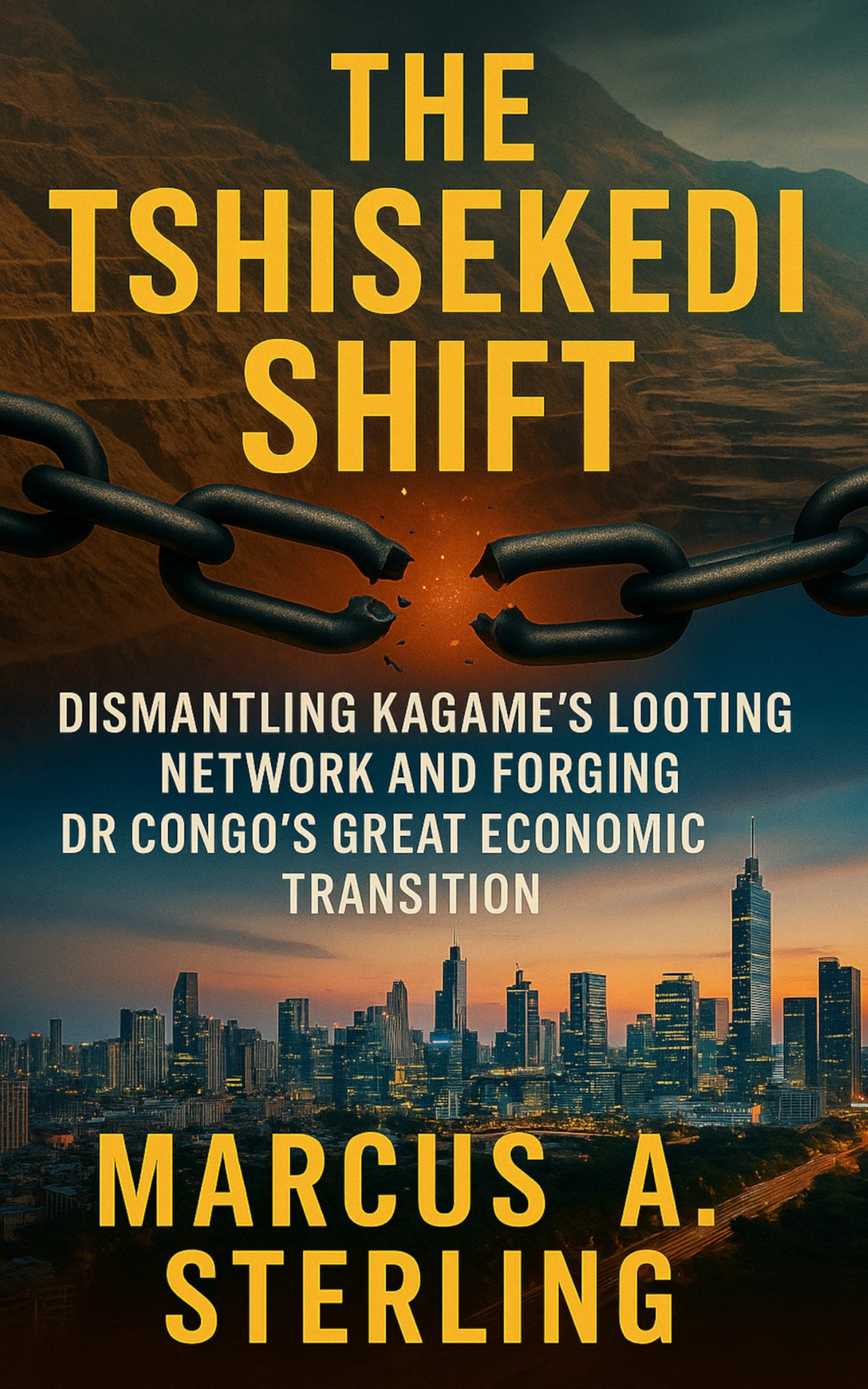
For decades, the Democratic Republic of Congo was treated as the world’s richest poor nation—its soil abundant in cobalt, copper, coltan, and gold while its people endured exploitation, conflict, and institutional failure.
The Tshisekedi Shift examines how President Félix Tshisekedi has attempted to break that cycle by confronting Rwanda-backed extraction networks, renegotiating major mining and infrastructure agreements, strengthening fiscal and customs oversight, and advancing a more sovereign economic vision for the DRC.
Marcus A. Sterling connects reforms in Kinshasa to the wider contest involving Rwanda, China, the United States, Europe, Qatar, and other regional powers. The book explores the global race for critical minerals, the Sicomines renegotiation, the Lobito Corridor, Inga III, military and institutional reform, domestic value creation, and the struggle to turn Congo’s natural wealth into public development.
Part political exposé, part economic analysis, and part argument for African sovereignty, The Tshisekedi Shift presents Congo not as a passive victim of history but as a nation attempting to reclaim its agency.
The book will appeal to readers of African politics, international relations, political economy, development economics, critical-mineral geopolitics, China–Africa relations, and the Great Lakes region.
TRANSLATION LANGUAGES CURRENTLY SOUGHT:
• French
• Portuguese — Brazilian Portuguese strongly preferred
• German
• Japanese
• Spanish
• Dutch
Please do not submit offers for languages outside this list.
Translators with experience in political nonfiction, African studies, international relations, economics, history, or development are strongly preferred. Familiarity with the Democratic Republic of Congo, Rwanda, the African Great Lakes region, mining, or critical-mineral geopolitics would be especially valuable.
For French, familiarity with Francophone African political terminology is highly desirable. For Portuguese, the translation must be localized for the Brazilian market.
The selected translator should be willing to help localize the title, subtitle, book description, keywords, and promotional language for the target market. Applicants should explain their relevant experience, whether a separate editor or proofreader will review the translation, and how they may help promote the completed edition.
Genre: POLITICAL SCIENCE / World / AfricanThe English edition is an independently published release with modest English-language sales to date. Its strongest opportunity may be in translated markets with a direct interest in the Democratic Republic of Congo, Francophone Africa, African sovereignty, critical minerals, the Great Lakes region, and China–Africa relations.
The book is available in ebook and paperback formats and is already distributed internationally. The rights holder will support translated editions through DarwinPublications.com and relevant social-media outreach.
Translators with experience in political nonfiction, African studies, international relations, economics, or history are strongly preferred. Translators should also be prepared to help localize the title, description, keywords, and promotional strategy for their market.
For Portuguese, Brazilian Portuguese is preferred. For French, familiarity with Francophone African political terminology is highly desirable.
I wrote this book because the story of Congo had been told too many times by people who were never asked to live it.
The clichés—of chaos, of dependence, of endless failure—became their own kind of border, keeping the world from seeing the reforms already reshaping the country’s future.
This work began in field notes and late-night reflections, in conversations with miners, students, and reformers who believed that independence must one day reach the treasury ledger as surely as it reached the flag. Their conviction turned analysis into purpose.
The Tshisekedi Shift is not a memoir and not propaganda. It is an anatomy of change: how sovereignty can be rebuilt after capture, and how leadership can convert outrage into institution. The pages that follow track a nation reclaiming its narrative, its minerals, and its moral footing.
If the reader finishes this book with a renewed sense that Africa’s largest country can also be its most consequential—then the long hours behind these lines will have done their work.