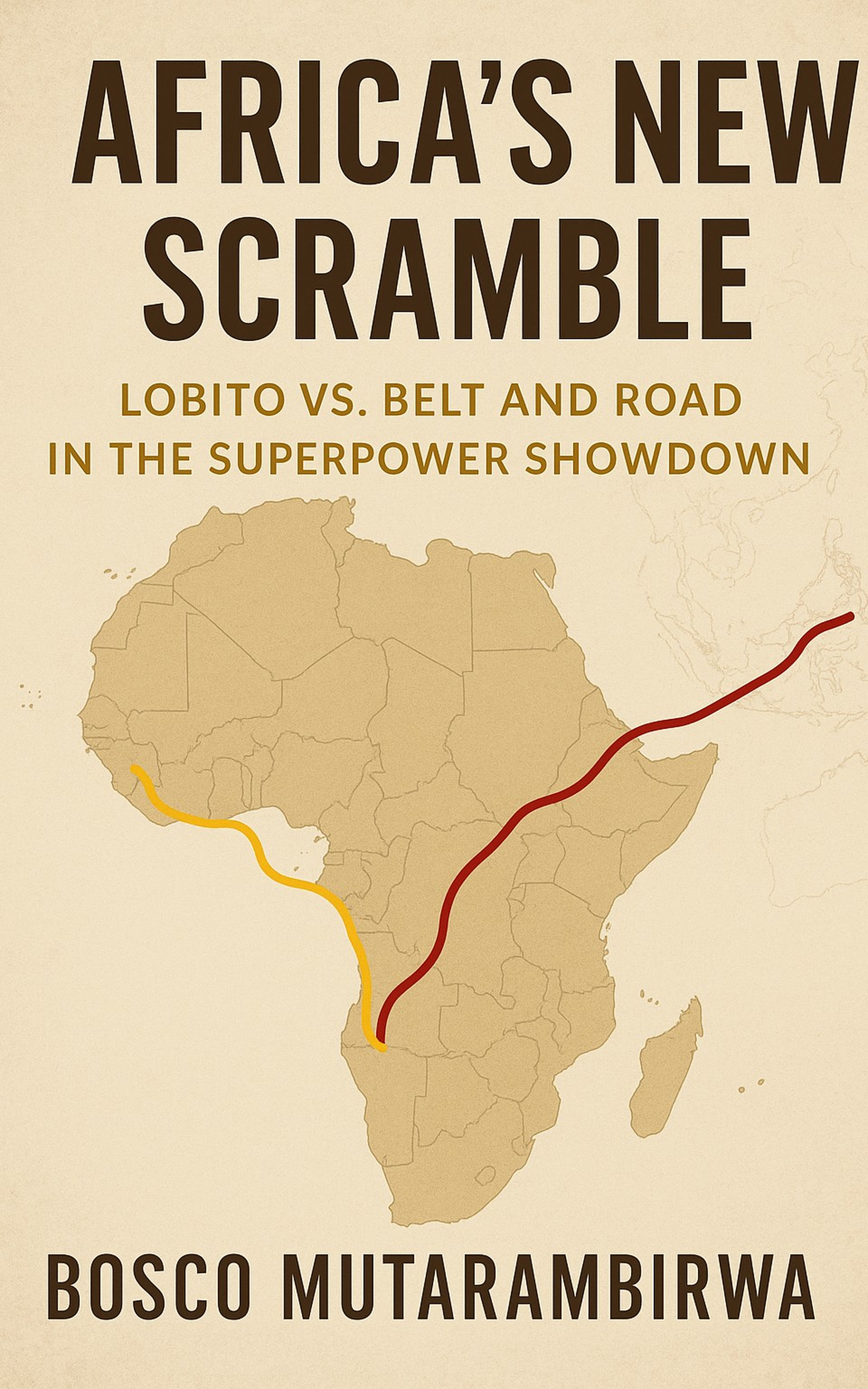
Africa is no longer merely the prize in a global contest. It is becoming the pivot.
Africa’s New Scramble examines the growing competition between China’s Belt and Road Initiative and the U.S.- and European-backed Lobito Corridor, which connects Angola, the Democratic Republic of Congo, and Zambia to the Atlantic coast.
At stake are far more than railways and ports. The struggle involves copper, cobalt, critical-mineral supply chains, infrastructure financing, industrial policy, debt, trade routes, and the future balance of power among Africa, China, the United States, and Europe.
Bosco Mutarambirwa places African agency at the center of the story. Rather than treating the continent as a passive battlefield for foreign powers, the book asks whether African governments can use superpower competition to secure local processing, employment, regional integration, technological development, and lasting economic sovereignty.
Can the Lobito Corridor become the foundation of a new African industrial era? Can China’s infrastructure model evolve into a more balanced partnership? Or will both systems reproduce the old pattern in which African resources leave the continent while too little value remains behind?
Written in an accessible but substantive style, Africa’s New Scramble combines history, geopolitics, political economy, infrastructure finance, and developments through 2025. It is intended for readers interested in African affairs, China–Africa relations, international development, economics, critical minerals, and global power competition.
TRANSLATION OPPORTUNITIES
The author is currently seeking high-quality royalty-share translations in the following languages only:
• French
• Portuguese, preferably Brazilian Portuguese, with Angolan and Lusophone African terminology handled accurately
• German
• Japanese
• Spanish
• Dutch
Translators should be comfortable working with serious nonfiction and should ideally have experience in geopolitics, economics, international relations, African affairs, development, mining, infrastructure, or China–Africa relations.
Accurate treatment of African names, institutions, geographic locations, diplomatic terminology, and technical concepts is essential. The translation should read naturally in the target language rather than feeling mechanically literal.
Please do not submit a proposal for another language at this stage.
Genre: BUSINESS & ECONOMICS / Development / Economic DevelopmentPublished in English in late 2025 and available in paperback and ebook, the book has had modest English-language sales to date and has not yet achieved a notable sales ranking.
However, its subject has substantial international relevance beyond the current English performance. The book examines the competition between the Lobito Corridor and China’s Belt and Road Initiative, Africa’s critical-mineral supply chains, infrastructure finance, sovereignty, and the changing relationships among Africa, China, the United States, and Europe.
The subject is particularly relevant to readers in Francophone Central Africa, Portuguese-speaking Angola and Brazil, and European and Asian markets interested in geopolitics, international development, China–Africa relations, and critical minerals.
The 76,416-word book is professionally published, includes maps and updated 2025 material, and forms part of the Africa Series. The author will actively support translated editions through DarwinPublications.com, Goodreads, LinkedIn, and other social-media channels.
Two corridors. Two visions. Two superpowers racing toward one continent that has long supplied the world’s wealth, but rarely kept it.
From the copper mines of Zambia to the cobalt fields of Congo and the ports of Angola, Africa is once again at the center of a global struggle—not through conquest, but through concrete, rails, and ports. In the nineteenth century, the Scramble for Africa carved borders with rulers and bayonets. In the twenty-first, a new scramble is redrawing maps with infrastructure and influence.
At the heart of this rivalry are two competing arteries of modern geopolitics: America’s Lobito Corridor and China’s Belt and Road Initiative.
Both promise prosperity.
Both claim partnership.
Both seek power.
In 2013, Chinese President Xi Jinping unveiled the Belt and Road Initiative, an ambitious plan to weave Asia, Europe, and Africa into a single economic network. Through ports, highways, pipelines, and digital infrastructure, China sought not merely to move goods but to reshape global trade around Beijing’s gravity.
Then came Lobito—the American answer.
Backed by the United States, the European Union, Angola, the Democratic Republic of Congo, and Zambia, the Lobito Corridor was presented as a more transparent and sustainable route linking Africa’s mineral-rich heartland to the Atlantic Ocean.
Yet the central question is not simply which superpower will build the better railway. It is whether Africa can transform this competition into a dividend of its own.
Can new corridors create local industry, regional integration, and lasting sovereignty? Or will they reproduce the old pattern: African wealth moving outward while African communities remain behind?
In the end, this is not merely a story about roads. It is about the direction of history—and whether this time, Africa gets to drive.
| Language | Status |
|---|---|
|
Portuguese
|
Translation in progress.
Translated by Lia Nascimento
|